
Duluth, MN
Concrete and Heavy Debris Disposal in Duluth
Concrete, brick, block, asphalt, dirt and basalt from Duluth's hillside are dense enough to hit a truck's legal weight limit long before a container looks full. We size by weight, not volume, and won't lift a load that's over the line. Flat rate, no scale-ticket surprises.
- Same dayDelivery available
- Flat rateQuoted up front
- Since 2013Locally owned
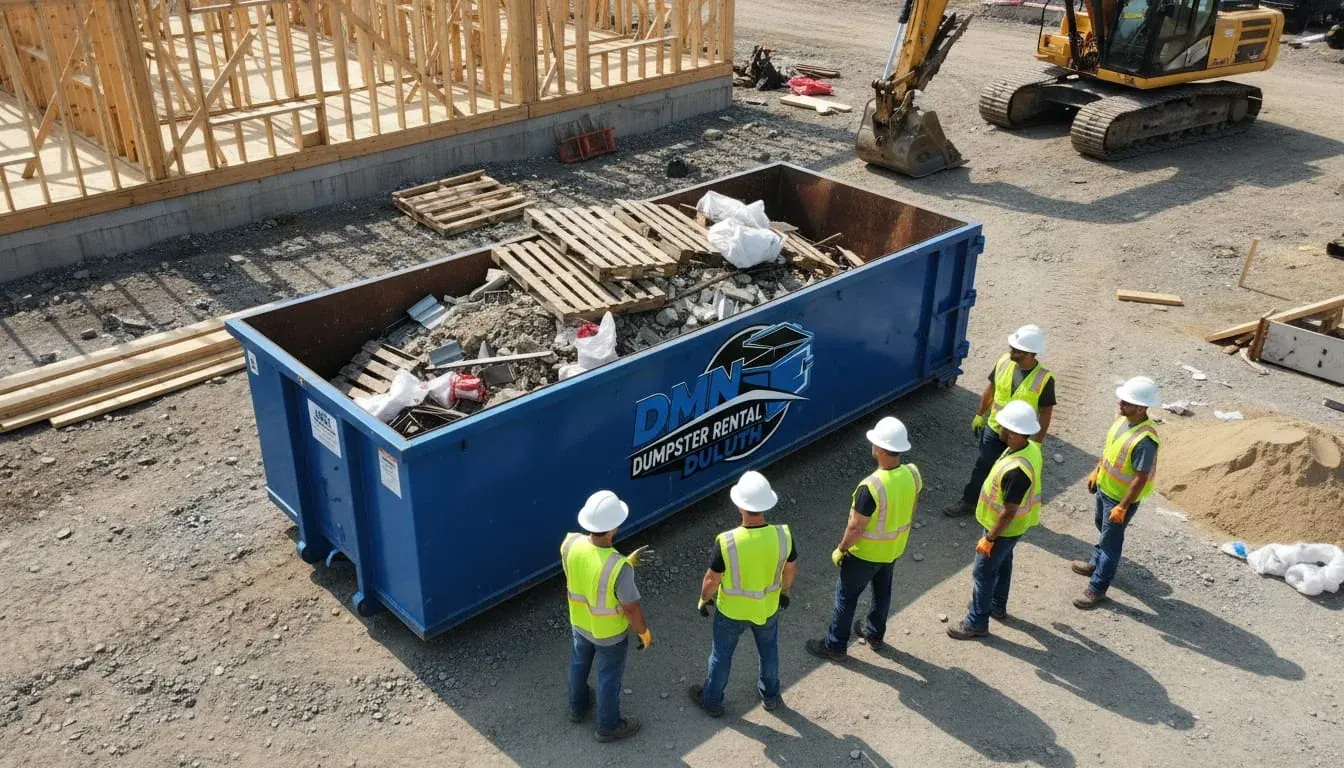
Most dumpster rentals are a volume question: how much stuff, what size box. Concrete and heavy debris flip that around. A cubic yard of broken concrete weighs about as much as a small car, and a roll-off truck has a legal weight it can carry whether the box looks full or not. Order the wrong size and you don't get a "little extra" charge — you get a container the truck cannot legally lift off your driveway.
We deliver a lot of dedicated heavy-debris containers around Duluth, because the ground here hands us more of this work than most places do. The hillside is stacked with basalt and bluestone foundations and retaining walls, our winters heave concrete driveways, sidewalks and aprons on a schedule you could set a watch by, and Minnesota layers spring load restrictions on top of the normal weight limits for a solid stretch of the year. None of that is a reason to guess. Tell us what you're tearing out and we'll size the container to the material, not the hole it leaves behind.
Flat-rate pricing, and if a load comes in over what the truck can legally carry, we'll say so before it becomes your problem out on the road.
What we handle on concrete & heavy debris jobs
- Dedicated 10 and 15 yard heavy-debris containers rated for concrete, brick, block and stone
- Flat-rate pricing so the number we quote on the phone is the number you pay
- We weigh loads and will not lift or transport a container over its legal weight rating
- Clean concrete, brick and asphalt recycled as aggregate through local transfer stations, not landfilled
- Frost heave driveway, sidewalk and apron tear-out is the job we handle most on the hillside
- Basalt, Duluth gabbro and bluestone foundation and retaining wall removal, common across the older city
- Deliveries planned around Minnesota spring load restrictions on county and state roads each spring
- Licensed and insured, family-run out of West Duluth since 2013, serving the Twin Ports and Douglas County WI
Weight Is the Problem, Not Volume
A dumpster is rated to hold a certain tonnage before it's legally too heavy to move — not because the box would tip, but because a loaded roll-off truck has to stay under the weight limits set for public roads. Concrete, brick, block, asphalt, stone and dirt are all dense enough to blow past that tonnage while the container still looks half empty. That's the whole reason a dedicated heavy-debris container exists: it's built shorter and stouter than a standard box, sized so a full load is still a legal load.
Here's roughly what you're dealing with, by material, per cubic yard:
| Material | Approx. weight per cubic yard |
|---|---|
| Broken concrete (with rebar) | 2,000–3,000 lb |
| Brick | 3,000–3,500 lb |
| Concrete block | 2,400–3,000 lb |
| Asphalt (broken) | 2,000–2,700 lb |
| Clean fill dirt (dry) | 2,000–2,200 lb |
| Wet clay | 2,700–3,200 lb |
| Stone / gravel | 2,400–2,900 lb |
| Roofing tear-off debris | 1,800–2,200 lb |
Put a full 20 yard of broken concrete on paper and you're at 20 to 30 tons. No roll-off truck on the road is built to carry that, which is why we send a 10 yard or 15 yard heavy container instead of the bigger box that would be the obvious answer for anything else.
Duluth's Hillside: Basalt, Bluestone and Retaining Walls
Older Duluth was built into a hillside with whatever rock was underfoot, and that rock is dense. Basalt and Duluth gabbro show up in foundations, garden walls, front steps and retaining walls all over the hillside neighborhoods, and quarried bluestone is common on older steps and walkways closer to downtown. Because so much of the older city sits on real grade, retaining walls here aren't decorative — they hold the yard up. When one fails or gets replaced, you're not moving landscaping timbers, you're moving stone that runs close to 3,000 pounds a cubic yard.
We size these jobs by asking what the wall or foundation was built from before we ask how big the pile looks. A basalt retaining wall that looks like a modest afternoon's work can out-weigh a much bigger pile of framing lumber.
Frost Heave: The Cycle Behind Most of This Work
Duluth runs a real freeze-thaw cycle — ground that freezes deep by December and doesn't fully let go until spring, with plenty of freeze-thaw swings in between. Water gets under a slab, freezes, expands, and lifts it a fraction of an inch. It doesn't settle back evenly. Do that every winter for fifteen or twenty years and a driveway, sidewalk or apron that was flat when it was poured ends up cracked, heaved and tripping people. That cycle, more than age or bad workmanship, is what drives most of the concrete tear-out we haul in this city.
It also means the damage is predictable on a rough schedule. If your driveway heaved last winter, it will likely heave again unless the base under it gets rebuilt, not just re-poured. When contractors call us for a tear-out, this is usually why. Delivering in the cold months has its own wrinkles too — see our winter dumpster rental guide for how we handle frozen ground on placement.
Spring Load Restrictions and the Legal Weight Limit
Two different weight rules stack on top of each other here, and the second one is the one out-of-town haulers get wrong. First, the standing rule: a fully loaded truck is generally capped around 80,000 pounds gross on most roads, with individual axles limited to roughly 20,000 pounds on a single axle and 34,000 on a tandem, spread out under the federal bridge formula. That number decides whether a full 10 yard of concrete can legally leave your driveway on an ordinary day.
Second, spring load restrictions. Every year, as frost comes out of the ground, county and state roads in this part of Minnesota post reduced axle limits — commonly down to about 10 tons per axle on paved county roads and as low as 5 tons per axle on gravel — for a window that typically runs from March into May, with exact dates set annually by zone. MnDOT posts the same kind of restriction on state highways. A load that's perfectly legal to haul in August can be over the line in April on the same road. We track the posted restrictions every spring and plan heavy hauls around them; call (218) 514-6269 before you schedule a big concrete tear-out for late March or April and we'll tell you what's posted that week. If placement itself needs a permit, our Duluth permit guide covers that separately from the weight rules here.
Clean Concrete Costs Less Than Contaminated Concrete
Concrete, brick and asphalt that come out of the ground clean are recyclable. Transfer stations serving this area crush accepted concrete, brick and blacktop and put it back to work as aggregate and road base, which is why clean loads are typically the cheaper category to dispose of. "Clean" generally describes the material itself, not a rebar-free requirement. Embedded rebar and wire mesh are routine in demolition concrete and get pulled out magnetically during crushing at most facilities, so you don't need to chase every bar out of a slab before it goes in the container.
What does knock a load out of the clean category is everything else that tends to ride along on a tear-out: wood, drywall, roofing, trash, insulation, or dirt mixed in past a light coating. Keep the concrete pile separate from the demo pile on site and the container we send for it stays in the cheaper, recyclable stream instead of getting priced as mixed construction debris. Our WLSSD recycling guide walks through what the local transfer stations accept and what gets crushed for aggregate.
Why We Will Refuse to Lift an Overweight Container
If a heavy-debris container comes in over its rated weight, we won't hook it and drive off — and that's not us being difficult. An overweight roll-off is a truck out of compliance the moment it touches the road, which is a liability for our driver, a real safety issue on a hill grade, and a problem in your name if the load ever gets weighed. We'd rather have that conversation in your driveway, with a plan to split the overage into a second container, than have it happen at a scale.
This is also why we ask questions before we deliver rather than after. Tell us it's a basalt retaining wall, a driveway slab, or a mix of dirt and block, and we'll send the right size the first time — a demolition job and a straight construction cleanup load size very differently once weight, not volume, is the constraint.
Right-sized
Which dumpster for concrete & heavy debris in Duluth?
We would rather talk you down a size than sell you air. These are the boxes that suit this work.
10 Yard Dumpster Dumpster
The default for a driveway tear-out, a retaining wall removal, or a load of clean broken concrete. Low sides, short footprint, and it hits its weight rating long before it looks full, which is exactly the point.
Size details 15Cubic yards15 Yard Dumpster Dumpster
A step up when the concrete is mixed with some lighter demo debris, like a patio tear-out that also pulled up a wood deck, or a basalt retaining wall with soil behind it.
Size details 20Cubic yards20 Yard Dumpster Dumpster
Only for genuinely mixed loads where heavy material is a modest fraction of the total, such as a garage demo with a concrete slab. We'll tell you on the phone if your job needs the 10 instead.
Size detailsLocal knowledge
Concrete & Heavy Debris across Duluth and St. Louis County
DMN Dumpster Rental Duluth runs out of West Duluth at 5713 Roosevelt St, and heavy-debris containers are a big part of what leaves that yard. We deliver concrete and heavy debris containers across Duluth and the Twin Ports, into Superior and Hermantown, down to Proctor and Cloquet, and out along the North Shore to Two Harbors, plus St. Louis, Carlton and Lake counties in Minnesota and Douglas County, Wisconsin.
Two agencies set the rules that actually govern this work. MnDOT's seasonal load limits page posts current restrictions by zone for state highways, and St. Louis County's spring load restrictions page covers county roads, which is where most residential deliveries actually happen. We check both before scheduling a heavy load in March and April. For where clean concrete and demolition debris end up, WLSSD's disposal guide is the reference we point contractors to.
Dan Nyberg has run this yard since 2013, licensed and insured, and every quote on a heavy-debris job is flat rate before the truck leaves Roosevelt Street.
Towns we cover
We run concrete & heavy debris out of our Roosevelt Street yard across Duluth and the surrounding suburbs.
FAQs
Concrete & Heavy Debris questions, answered
How much does a 10 yard heavy debris dumpster cost in Duluth?
It depends on the material and the tonnage allowance, not just the box size. Clean broken concrete, brick or asphalt prices lower than a mixed load with dirt, wood or trash in it. Tell us what's coming out and we'll give you a flat number before we deliver.
Can I put dirt and concrete in the same dumpster?
You can, but it usually costs more. Dirt mixed into a concrete load takes it out of the clean, recyclable category and into mixed heavy debris, which is priced differently. If you have a real volume of both, we'll often size two separate loads instead of combining them — ask when you call.
Does rebar disqualify concrete from being 'clean'?
Generally no. Embedded rebar and wire mesh are normal in demolition concrete, and most facilities pull it out magnetically during crushing. What actually contaminates a load is wood, trash, roofing, insulation or a heavy coating of dirt mixed in — keep that separate and the concrete stays in the cheaper category.
Why would a 10 yard dumpster be the right size for a big driveway tear-out?
Because weight, not the size of the driveway, is what limits the load. A 20 yard filled with broken concrete could weigh 20 tons or more, which no roll-off truck can legally haul. A 10 or 15 yard heavy container is sized so a full load stays under the legal limit. See our 10 yard dumpster page for dimensions.
How do spring load restrictions affect my delivery date?
From roughly March into May, St. Louis County and MnDOT post reduced axle weight limits on county and state roads while frost comes out of the ground. A loaded heavy-debris truck that's legal in July can be over the posted limit on the same road in April. We check current restrictions before scheduling concrete and heavy debris jobs in that window and will tell you if your delivery needs to shift a few days.
What if my container ends up too heavy to haul?
We'll tell you before it leaves your driveway, not after. An overweight roll-off isn't something we'll hook up and drive — it's a safety and compliance issue for the driver and, on a hill grade, a real risk. We'll split the overage into a second container rather than send an illegal load down the road.
Ready when you are
Book concrete & heavy debris in Duluth
Call and you will speak to someone local who knows the streets, the permit rules and which box actually fits your driveway. Flat rate quoted up front.
Keep going
Related services
Roll-Off Dumpster Rental
10 to 40 yard roll-off containers delivered across Duluth and Superior.
View serviceEstate Cleanout Dumpsters
Patient, discreet service for probate, downsizing and a move into care.
View serviceResidential Dumpster Rental
Driveway containers for cleanouts, remodels and downsizing across the Twin Ports.
View service