Duluth, MN
Roll-Off Dumpster Rental in Duluth, MN
A straight answer on how roll-off dumpsters actually work in Duluth: the full size range, what flat pricing really covers, delivery-day logistics, and the access a truck needs on our hillside streets and alleys. Family-owned, licensed, and insured since 2013.
- Same dayDelivery available
- Flat rateQuoted up front
- Since 2013Locally owned
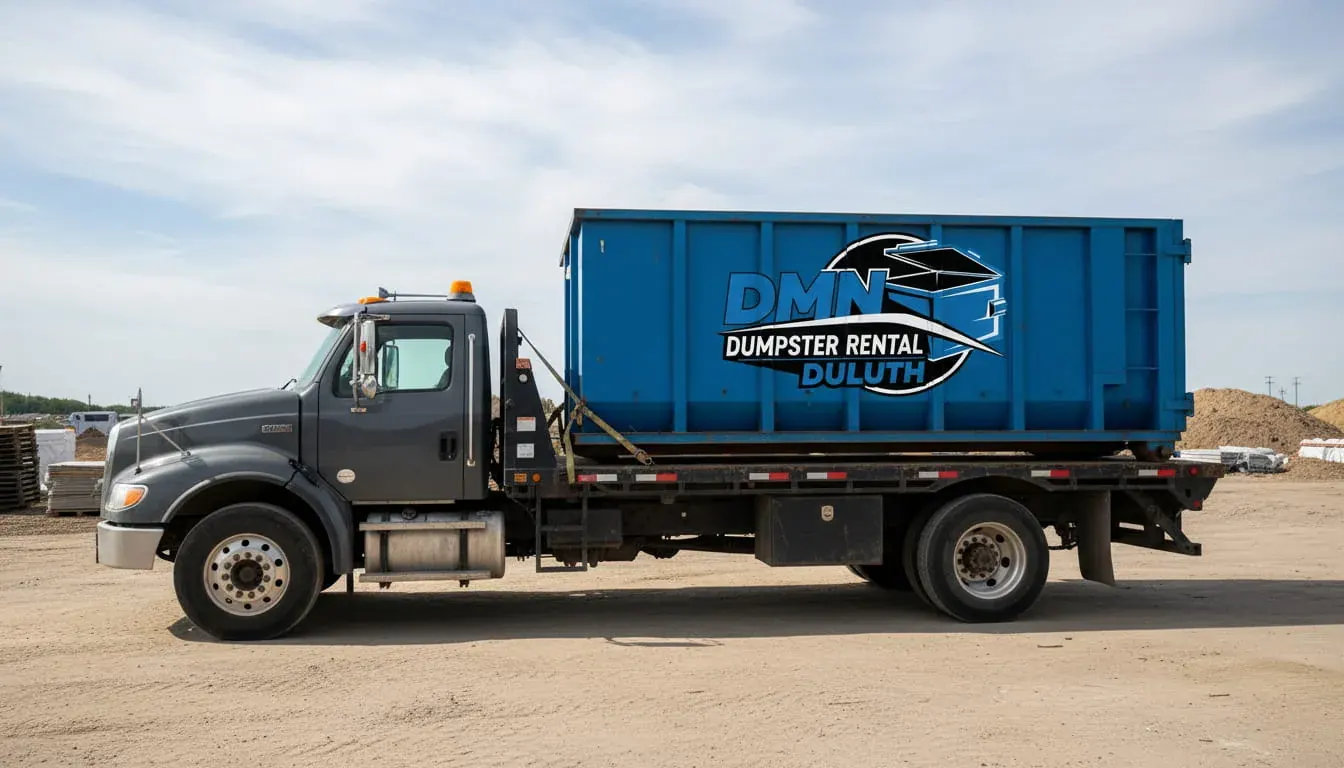
A roll-off dumpster is the open-top steel container you see sitting on a rail system, dropped and pulled by a hook-and-cable truck. It is not a bagster, not the front-load bin behind a restaurant, and not a trailer you tow home from the hardware store. That difference drives everything else on this page: how much room the truck needs, how the box gets loaded, and what it costs to have one sitting in your driveway or alley for a week.
We have dropped roll-offs on Duluth's hillside streets, West Duluth alleys, and Twin Ports job sites since 2013. Dan Nyberg runs this outfit out of 5713 Roosevelt St, and every container leaves our lot on a flat rate that covers delivery, a set rental period, a tonnage allowance, and pickup - no surprise trip charges tacked on after the fact.
This page walks through the full 10 to 40 yard range, what our flat rate covers versus the teaser-rate model some haulers run, the access a truck needs to place and tip a box safely, and the loading rules that keep a job moving instead of stalling out. If you already know your size, jump to the size guide. If you just want a number, call (218) 514-6269.
What we handle on roll-off dumpster rental jobs
- Flat rate covers delivery, rental period, tonnage allowance, and pickup - one number, no surprise fees
- Full size range from 10 to 40 yards, sized to the job over the phone
- Same-day delivery when you call before noon
- Driveway protection boards set under every container, standard, no extra charge
- Family-owned and operated by Dan Nyberg out of West Duluth since 2013
- Licensed and insured for residential, commercial, and construction placements
- Experience with steep hillside driveways and narrow alleys across Duluth's neighborhoods
- Serving Duluth, the Twin Ports, St. Louis, Carlton, and Lake counties, and Douglas County, WI
What a Roll-Off Actually Is (and What It Isn't)
A roll-off container rides on a set of steel rails welded to its underside. The delivery truck backs up to the drop spot, tilts its bed, and winches the box off the rails with a cable and hook, sliding it straight back onto the ground. Pickup reverses the process: hook, winch, tilt, drive away. That mechanism is why a roll-off needs a straight, mostly flat approach behind it - the box has to slide in a line, not swing sideways like a trailer being backed into a garage.
It is worth being specific about what a roll-off is not. A bagster or similar bag-style unit is a woven fabric sack you fill by hand and a crane truck lifts off later - fine for a small cleanout, useless for a roofing tear-off or a kitchen demo. A front-load bin is the steel box with a lid that a commercial hauler services weekly with a forked lift-gate truck; those are built for ongoing commercial waste, not a one-time project, and they load from the top through a small opening rather than over an open rail. A dump trailer is towed behind a pickup, has shorter walls, and works fine for light yard debris but tips easily if you load it heavy or uneven. For a demolition, a roofing job, a full basement cleanout, or a construction project, a roll-off on rails is what you want - see our construction dumpster rental and roofing dumpster rental pages for job-specific notes.
Sizes: 10 to 40 Yards, and How They Compare
We run the full range because Duluth jobs run the full range - a single-car garage cleanout is a different animal than a full tear-off on a Congdon two-story. Here is how the sizes stack up:
| Size | Approx. Dimensions | Typical Load | Best For |
|---|---|---|---|
| 10 yard | 14' L x 7.5' W x 3.5' H | 3-4 pickup loads | Small cleanouts, single-room remodel, yard debris |
| 15 yard | 16' L x 7.5' W x 4.5' H | 4-6 pickup loads | Garage or basement cleanout, deck tear-off |
| 20 yard | 16' L x 7.5' W x 6' H | 6-8 pickup loads | Roofing tear-offs, flooring, mid-size remodels |
| 30 yard | 22' L x 7.5' W x 6' H | 10-12 pickup loads | Whole-house cleanouts, additions, siding jobs |
| 40 yard | 22' L x 7.5' W x 8' H | 16+ pickup loads | New construction, full demolition, commercial jobs |
Height matters as much as length on a lot of Duluth properties, because a taller box needs more overhead clearance while it tips on delivery and pickup - see the access section below. If you are not sure which one fits your project, our size guide walks through it room by room, or just call and describe the job.
What Flat-Rate Pricing Covers - and What Teaser Rates Leave Out
Our flat rate is one number that covers delivery, the rental period, a set tonnage allowance, and pickup. You know the total before the truck ever leaves the yard. That is not how every hauler in the region prices a job. The teaser-rate model advertises a low base price, then adds a delivery fee, a "environmental" fee, a per-day charge past a short included window, and an overage fee calculated per ton once you cross the included allowance - often disclosed only in fine print or after the box is already sitting on your driveway.
The two numbers that actually decide your final cost are rental days and tonnage. A roofing tear-off or shingle load is heavy for its volume and burns through a tonnage allowance fast even in a container that still looks half-empty; a bulky but light load like furniture or drywall debris does the opposite. When you call (218) 514-6269 we ask what is going in the box, not just what size you want, because that is what keeps the flat rate flat. Full pricing detail and real job examples are on our dumpster rental cost guide.
Delivery Day, Step by Step
Call or book before noon and we can usually get a container out same day - see our same-day dumpster rental page for how that works on short-notice jobs. Otherwise here is the sequence:
- We confirm the drop spot with you over the phone - driveway, street, or alley - and flag anything that changes the approach, like a steep grade or low tree branches.
- The driver backs the truck in along a straight line to the spot and sets down driveway protection boards before the container ever touches the ground.
- The box slides off the rails onto the boards. The driver checks it sits level; a container tilted on a slope loads and drains unevenly and is harder to fill correctly.
- You get a quick walk-through on loading limits and what to keep out of the box.
- When you are done, call for pickup. The driver hooks the rails, tips the bed, and pulls it out along the same straight approach.
Need the box longer, or need it swapped for an empty one mid-project? Both are routine - see swap-outs and extensions below.
Access Requirements and Duluth's Hills
A roll-off truck needs roughly 60 feet of straight approach behind the drop spot, about 10 to 12 feet of width to maneuver, and clear overhead space while the bed tips - figure on 20-plus feet of vertical clearance during the actual drop and pickup, even though the loaded box itself sits well under that. Overhanging branches, power lines, carports, and low garage eaves all factor in, and we check for them before the truck rolls.
Duluth's terrain adds a layer most flatland cities do not deal with. A lot of the hillside neighborhoods - Piedmont, Hunters Park, Congdon, Chester Park, Duluth Heights - sit on driveways with real grade to them, and some alleys behind West Duluth and Lincoln Park lots are narrow and pitched. A steep driveway can still work, but it usually means placing the container lower on the grade, near the street, rather than up against the garage. We have written up the specifics in our steep driveway placement guide, and it is worth a read before delivery day if your driveway has any real pitch to it.
We set protection boards under every container on asphalt, pavers, or a finished driveway as standard practice, no extra charge, to spread the load and stop rail marks. If there is no safe or legal spot off the road, the box can go in the street, but that requires a right-of-way/obstruction permit from the City of Duluth's Engineering permits office - we can walk you through what that involves, and our permit guide covers it in more depth. Assume you'll need one before assuming the truck can just park in the lane.
Loading Rules, What Can Go In, and Winter Considerations
Load level with the top rail - a heaping load over the rail is an overfilled load, and it is both a road hazard and something a driver can legally refuse to haul or have to reload before transport. Spread weight evenly and keep heavier material like shingles, concrete, or dirt low and centered rather than piled to one side; an unbalanced load makes the box harder and less safe to lift.
Minnesota rules keep certain items out of a general roll-off regardless of size: tires, appliances containing refrigerant, car batteries, paint and other liquids, and anything classed as hazardous waste. Our what can go in a dumpster in Minnesota page has the full breakdown, and the WLSSD banned items list is the authoritative reference we work from for the Duluth side. If your job is across the bridge in Superior or elsewhere in Douglas County, Wisconsin runs different construction and demolition debris rules through the Wisconsin DNR - tell us the job is on the Wisconsin side and we will flag anything that changes.
For projects that generate more debris than one box holds, we run swap-outs - pulling a full container and dropping an empty one on the same visit - and can extend a rental period if the job runs long. In winter, frozen ground actually gives a stable base for placement, but ice on the approach and driveway is the real hazard, so give us a call before delivery if your access has not been cleared. Come spring thaw, soft ground and mud mean the driveway boards matter even more, particularly on unpaved pads. Details on cold-weather scheduling are in our winter dumpster rental guide.
Right-sized
Which dumpster for roll-off dumpster rental in Duluth?
We would rather talk you down a size than sell you air. These are the boxes that suit this work.
15 Yard Dumpster
The workhorse for a garage or basement cleanout, a deck tear-off, or a mid-size remodel - big enough to not run out of room, small enough to fit tighter driveways.
Size details 20Cubic yards20 Yard Dumpster
Our most-called-for size for roofing tear-offs and flooring jobs; the extra height handles bulky, mixed debris without needing a swap-out.
Size details 30Cubic yards30 Yard Dumpster
Built for whole-house cleanouts, additions, and siding projects where a 20 would mean a second trip and a 40 would be more truck than the driveway can handle.
Size detailsLocal knowledge
Roll-Off Dumpster Rental across Duluth and St. Louis County
We work out of 5713 Roosevelt St in West Duluth, which puts us close to the whole footprint we cover: the hillside neighborhoods running from London Road up through Piedmont and Duluth Heights, the flatter grid through Lincoln Park and Riverside, and out along the Twin Ports into Superior and Douglas County, Wisconsin. That hillside geography is the single biggest variable in placing a roll-off here - a straight, level approach is easy to find in some neighborhoods and a real planning problem in others, and we account for that on every call rather than assuming a standard driveway.
Disposal rules follow the same split. Jobs on the Minnesota side run through the Western Lake Superior Sanitary District, and we work off the WLSSD banned items list for what can and cannot go in a container. Jobs across the bridge fall under Wisconsin DNR construction and demolition rules, detailed on the Wisconsin DNR debris page, which differ enough from Minnesota's that it is worth telling us up front which side of the state line the job sits on. If a container needs to sit in the street rather than a driveway, the City of Duluth's permits office handles the right-of-way paperwork. We have run this route since 2013 and can tell you in one phone call, before a truck moves, what your address and project are going to require.
Towns we cover
We run roll-off dumpster rental out of our Roosevelt Street yard across Duluth and the surrounding suburbs.
FAQs
Roll-Off Dumpster Rental questions, answered
Do I need a permit to put a dumpster in my driveway in Duluth?
No, a permit is not required for a container placed entirely on your own driveway or private property. A permit from the city is only needed if the box has to sit in the street or otherwise obstruct the public right-of-way - see our permit guide for the details.
How much space does a roll-off truck need to deliver a container?
Plan on roughly 60 feet of straight approach behind the drop spot, 10 to 12 feet of width, and clear overhead space of about 20 feet while the truck tips its bed during drop-off and pickup. Overhanging trees and low wires are the most common obstacles we run into.
What size dumpster do I need for a roofing tear-off?
Most single-layer tear-offs on an average Duluth house fit a 20 yard container. Steeper roofs, multiple layers of shingles, or larger homes often call for a 30 yard - our roofing dumpster page and size guide can narrow it down based on roof size and layers.
Can a roll-off dumpster sit on a steep driveway?
Often yes, but the container may need to sit lower on the grade near the street rather than up by the garage, and the driver may need to reposition boards or the drop angle. Tell us about the slope when you call so we can plan the approach before the truck arrives.
What happens if I overfill the dumpster?
A load piled above the top rail is overfilled. The driver may ask you to remove material before pickup, or it may require a second trip - either way it is safer and cheaper to keep the load level with the rail from the start.
Can I get a dumpster delivered in winter or during spring thaw?
Yes, we deliver year-round. Frozen ground gives a stable base, but a cleared and de-iced approach matters for safe placement. In spring thaw, soft or muddy ground makes our driveway protection boards even more important, especially on gravel or unpaved pads.
Ready when you are
Book roll-off dumpster rental in Duluth
Call and you will speak to someone local who knows the streets, the permit rules and which box actually fits your driveway. Flat rate quoted up front.
Keep going
Related services
Roofing Dumpster Rental
Tear-off boxes sized by squares and layers — ice-dam season included.
View serviceYard Waste Removal
Minnesota bans yard waste from landfills — we keep it separate and compliant.
View serviceEstate Cleanout Dumpsters
Patient, discreet service for probate, downsizing and a move into care.
View service