
Where Duluth's Waste Actually Goes: A WLSSD and Recycling Guide
How WLSSD manages Duluth's waste, what Minnesota and Wisconsin landfill bans mean for your dumpster, and where common items actually end up.
Duluth dumpster guide
A West Duluth operator's guide to getting a roll-off dumpster safely onto hillside driveways, alleys, and street placements from Congdon to Denfeld.
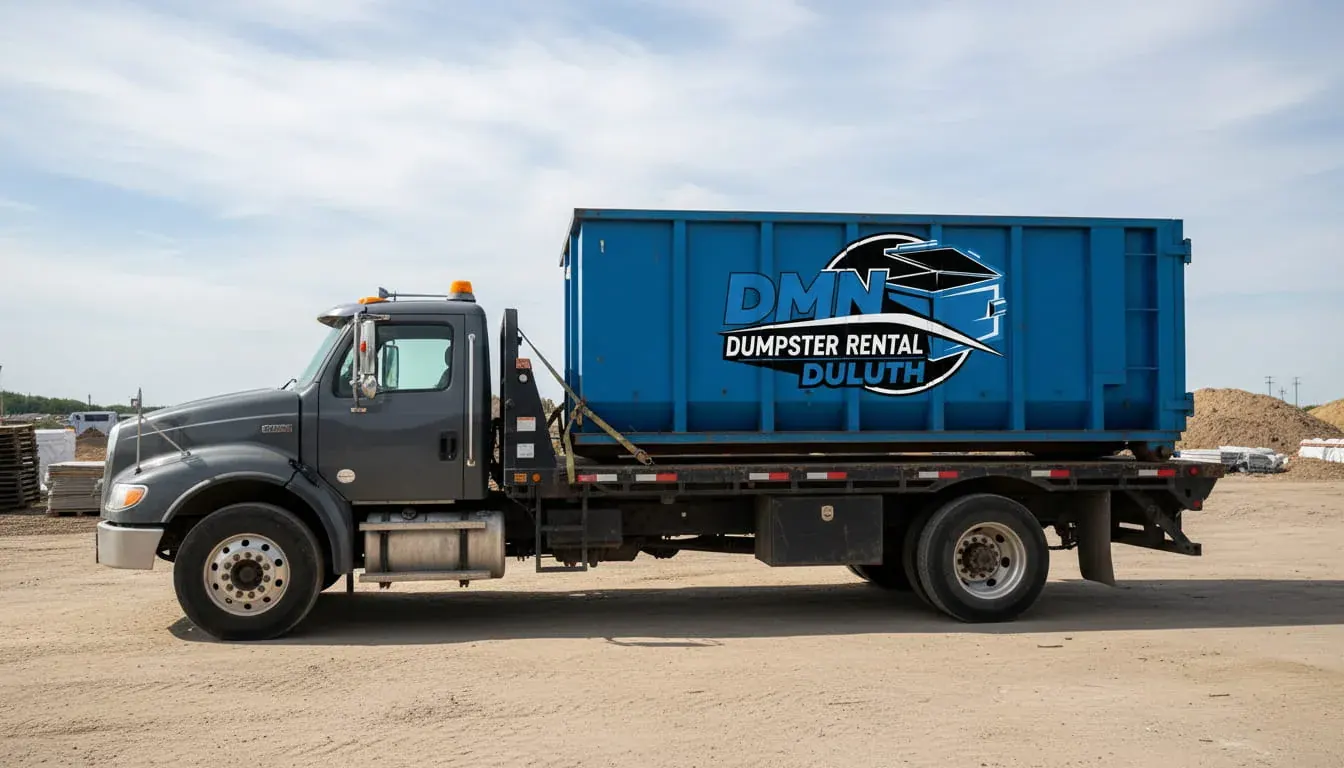
Duluth climbs roughly 800 feet from the shore of Lake Superior in about a mile and a half in places, and every avenue between Skyline Parkway and the water reflects it. We've been dropping and pulling roll-off boxes on those hillside streets since 2013, and the truth is that a good chunk of our pre-delivery calls in this town aren't about dumpster size at all — they're about whether the driveway will actually hold a loaded container without a fight. This is what we tell customers, in plain terms, before the truck ever leaves our yard on Roosevelt Street.
A standard roll-off delivery truck needs about 60 feet of straight, unobstructed approach to set a container down cleanly, 10 to 12 feet of width along that path, and enough overhead room to tip the box off the rails without catching gutters, eaves, or tree limbs. On a flat suburban lot that's rarely an issue. On a Central Hillside or East Hillside block where houses sit close together on a grid of steep numbered avenues, or on a Congdon Park street that curves along a ravine, you can run out of any one of those three things fast.
Grade eats into all three requirements at once. A driver backing a loaded trailer up a pitched street has less control and needs more room to correct. A driveway that rises sharply from the street reduces the truck's usable approach angle before the cable can even engage the container. And a steep lot often has retaining walls, porches, or rock outcroppings crowding the sides where a flat lot would have open yard.
An empty steel container weighs a few hundred pounds less than most people guess, and it is not anchored to anything once it's off the truck. On a driveway with real pitch, a container can shift a few inches every time someone tosses a heavy load in from one side, and over a week that becomes visible movement — what haulers call a box "walking." It's rarely dramatic, but it is a real risk to a driveway edge, a parked car, or a retaining wall below.
Our standard practice on any noticeable grade:
We've turned down driveway placements in steep pockets of Piedmont Heights and upper Chester Park where the grade simply wasn't safe for a loaded container, full stop. It's a short conversation and it saves everyone a bad afternoon.
A lot of Duluth's older hillside housing stock — especially through the Hillside neighborhoods, Woodland, and parts of Lincoln Park — was platted with rear service alleys, many of them gravel or narrow asphalt. Alley placement is frequently the best answer on a steep lot because it avoids the driveway apron pitch entirely and keeps the container off the public street, which sidesteps a permit in many cases. The catch is width: alleys in this city can run anywhere from a comfortable 16 feet to a genuinely tight 10 or 12 feet once you account for utility poles, fences, and parked resident vehicles. We ask about alley width specifically before we count on it, because a truck that can't square up to drop the box safely in an alley is worse than no alley option at all. Once the box is placed, loading it correctly matters too — see the Western Lake Superior Sanitary District's disposal guide for what belongs in a roll-off versus what needs separate handling.
When neither the driveway grade nor an alley works, the container goes in the street, and that changes the paperwork. The City of Duluth treats any dumpster or storage container left in the public right-of-way as an obstruction, which requires a Concurrent Use of Streets permit through the city's engineering and planning department before the box goes down — see the current application details at duluthmn.gov. On a hillside street, that review tends to be stricter, not looser: reviewers are weighing sight lines on a grade, snow removal access in winter, and whether parking a container on a pitched block narrows the lane enough to matter for fire and emergency vehicles. We walk customers through this on our Duluth dumpster permit guide, and we can pull the permit on your behalf when a street placement is the only option.
From roughly November through March, the city's snow and ice priorities add another layer: a container sitting on a steep block can interfere with plowing and can become a hazard itself if the street ices over around it. If your job is likely to run into winter, read our winter dumpster rental guide before you commit to a street placement on a hill.
We put boards under the rails on every delivery where the driveway isn't bare gravel, and on a hillside property it matters more than usual because the load isn't distributed evenly — more weight rests on the downhill rail. What that surface is made of changes the risk:
| Surface | Main risk on a grade | How we handle it |
|---|---|---|
| Older poured concrete | Cracking at the driveway apron where the slab meets the street, common on pre-war Duluth homes | Extra dunnage boards concentrated at the apron transition, not just under the container body |
| Asphalt | Rail indentation and scoring on hot summer days when asphalt softens | Full-length boards under both rails, delivery timed to cooler parts of the day when possible |
| Gravel or crushed rock | Rutting and container settling unevenly, worse on a slope | Wider dunnage footprint and a level check before the driver disconnects |
| Pavers or decorative drive | Cracked or displaced pavers under rail pressure | Plywood spread under the full container footprint, or we recommend an alternate surface |
The apron risk deserves its own mention. Duluth driveways frequently pitch sharply right where they meet the street, a holdover from decades of grading against the hillside, and that transition point takes concentrated stress every time a loaded container is pulled back onto the truck. It's the single spot we get asked about most after the fact, and it's entirely preventable with the right blocking placed before delivery, not after someone notices a crack.
This isn't hypothetical for us. Congdon Park and East Hillside properties routinely sit behind low fieldstone or timber retaining walls that narrow the usable driveway width by a foot or two on each side. Chester Park and Piedmont Heights lots often have bedrock outcroppings close to the surface that limit where a driveway can even be cut. Lakeside and Duluth Heights tend to have more room to work with, and Park Point — officially Minnesota Point — is the one part of our service area that's flat and sandy with none of these issues at all, which makes it one of the easiest placements we do all year.
A quick, accurate description up front means one trip, not two. When you call (218) 514-6269, have this ready:
For anything with real grade or a tight footprint, we'll do a quick site check rather than guess over the phone — a five-minute look at the driveway from the street tells our driver more than a phone description ever can, and it's free.
On a hard-access hillside lot, the right-sized container isn't always the biggest one that fits your project on paper. A 20-yard dumpster is our most requested size for full remodels, but if your driveway is narrow, steeply pitched, or has a tight turnaround, a 15-yard dumpster or a 10-yard dumpster sits lower, tracks less, and is far easier to place and pull safely on a grade. We'd rather schedule you for a second pull on a smaller box than force a 20-yard container onto a driveway that can't handle it. If you're not sure which size fits the job, our dumpster size guide walks through it, and our roll-off dumpster rental and residential dumpster rental pages cover what's included either way.
We've been placing containers on this hillside since 2013, flat-rate and no surprise fees, and same-day service is available for orders in before noon. If your property has any grade, alley access, or a tight approach, call (218) 514-6269 and describe it before you book online — it's the fastest way to make sure the box we send is the box that actually fits. You can also reach us through our contact page, and if timing is tight, ask about same-day dumpster rental.
FAQs
Often yes, with the right handling. We chock the container, position it across the slope rather than pointed downhill when the driveway width allows, and use extra blocking under the low-side rail. On driveways with severe pitch, we'll recommend the street, an alley, or a smaller box instead, because safety comes before convenience.
Yes. The City of Duluth requires a Concurrent Use of Streets permit for any container placed in the public right-of-way, and review tends to be stricter on hillside blocks due to sight lines, lane width, and snow removal access. We can help you apply through the city's engineering and planning department.
A 10-yard or 15-yard dumpster is usually the better fit when a driveway is narrow, steeply pitched, or has a tight turnaround, since it sits lower and tracks less than a 20-yard box. We'll ask about your access before recommending a size, and we'd rather schedule an extra pull than force a container onto a driveway that can't safely hold it.
Frequently, yes. Many Duluth Hillside, Woodland, and Lincoln Park properties have rear alley access, which avoids the steep pitch of a driveway apron and often avoids a street permit entirely. It depends on alley width, since some run tight once you account for poles, fences, and parked vehicles, so we confirm width before counting on it.
It does. From roughly November through March, containers left on a pitched street can interfere with plowing and create an icing hazard, which makes street-placement permits harder to get approved. If your project runs into winter, driveway or alley placement with good surface protection is usually the safer and faster route.
Ready when you are
Call and you will speak to someone local who knows the streets, the permit rules and which box actually fits your driveway. Flat rate quoted up front.
Keep reading
How WLSSD manages Duluth's waste, what Minnesota and Wisconsin landfill bans mean for your dumpster, and where common items actually end up.
Duluth dumpster sizing depends on weight, not just volume — especially in pre-1940 homes with plaster and lath. Here's how to pick the right size.

Size, rental period, tonnage, debris type, and access all move dumpster rental cost in Duluth. Here's what drives price and how to control it.