What Size Dumpster Do I Need? A Duluth Homeowner's Guide
Duluth dumpster sizing depends on weight, not just volume — especially in pre-1940 homes with plaster and lath. Here's how to pick the right size.
Duluth dumpster guide
How WLSSD manages Duluth's waste, what Minnesota and Wisconsin landfill bans mean for your dumpster, and where common items actually end up.
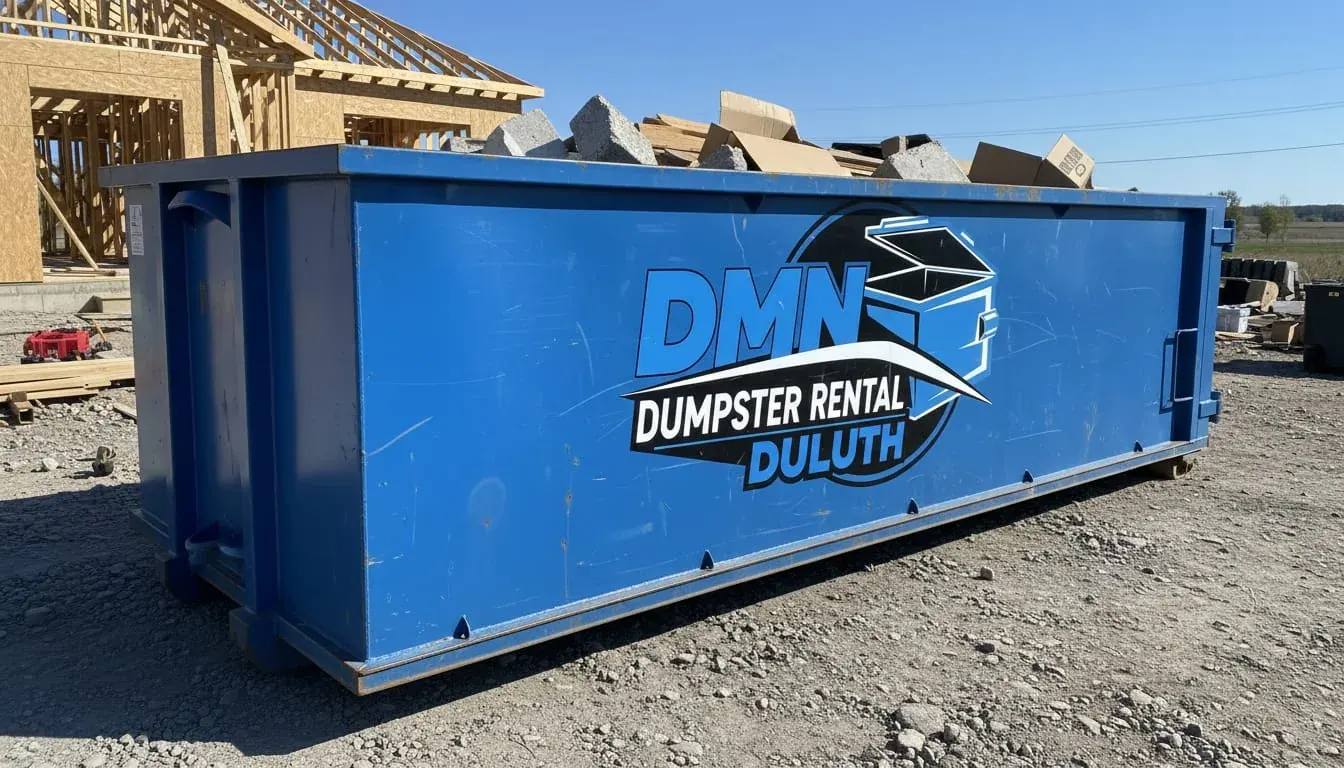
Most Minnesota cities hand solid waste off to a county contractor and move on. Duluth does not work that way. The city and its neighbors — Cloquet, Hermantown, Proctor, Rice Lake, Carlton, Scanlon, Thomson and Wrenshall — sit inside the Western Lake Superior Sanitary District, a special-purpose government agency the Minnesota Legislature created in 1971 to clean up pollution in the lower St. Louis River basin. WLSSD, now branded Resource Renew, runs the region's wastewater treatment plant, a yard waste and food scraps composting site, a household hazardous waste facility and a solid waste transfer station, all under one roof of authority. If you rent a dumpster in Duluth, understanding how that system sorts, bans and ships material will save you a rejected load and a wasted trip.
Duluth's original city landfill closed in 1999. Rather than opening a new one, the region built out a network of specialized drop-off sites and shifted disposal to a transfer station that consolidates waste for shipment out of the district. According to the City of Duluth's sustainability page, the WLSSD region generates roughly 124,000 tons of waste a year, of which about 45,000 tons are recycled, 5,000 tons are composted, and the rest is split between wastewater solids and material sent to landfills or hazardous waste facilities. That is a meaningfully higher diversion rate than a typical county drop-and-haul system, but it only works if residents and contractors sort correctly before the material ever reaches a dumpster.
WLSSD operates three separate sites that homeowners and contractors interact with most. Addresses and phone numbers below are current as of this writing per wlssd.com; hours change seasonally, so confirm on their site before you drive out.
| Facility | Address | What it takes |
|---|---|---|
| Materials Recovery Center | the WLSSD Materials Recovery Center on Ridgeview Road (confirm the current address on wlssd.com) | Small electronics and rechargeable batteries (free); TVs, monitors, computers, printers, microwaves, tires (fee); mixed household junk and construction debris (fee per cubic yard); business cardboard. Does not accept household garbage, hazardous waste, leaves or yard waste. |
| Household Hazardous Waste facility | 2626 Courtland St, Duluth, MN 55806 | Paint, automotive fluids and filters, cleaners and degreasers, pesticides and weed killers, rechargeable batteries, fluorescent bulbs, and medical sharps, free for residents. |
| Yard Waste Compost Site | 2626 Courtland St, Duluth, MN 55806 | Grass clippings, leaves and garden plants (free); brush, logs, dirt and sod (fee). Open seasonally, roughly the third week of April through the Saturday before Thanksgiving, Wednesday through Saturday. |
Notice that the Materials Recovery Center sits on the footprint of the old city landfill, and that it is a completely different address from the hazardous waste and compost sites. That split trips people up constantly — a homeowner loads paint cans and a bag of grass clippings into the same trip and ends up at the wrong building. When you rent a dumpster from us for a residential cleanout, we sort that logistics problem out for you; the container goes to the right facility automatically.
Minnesota Statutes chapter 115A does not treat all trash the same. Several categories are flatly banned from mixed municipal solid waste and disposal facilities statewide, which means they cannot legally go into a standard trash-bound dumpster load no matter which company hauls it:
None of these items belong in a roll-off dumpster headed for disposal, and a hauler who finds them mixed into a load can hold the container or bill for special handling. If you are unsure what a specific item falls under, our guide to what can go in a dumpster in Minnesota walks through the full list, and you can always call us at (218) 514-6269 before you load anything questionable.
We serve Superior, Oliver and Poplar in Douglas County, Wisconsin, in addition to the Minnesota side of the Twin Ports, and this is where the disposal picture genuinely shifts. A dumpster load is regulated by where it is actually disposed of, not by where the job site sits — so a Wisconsin job can still land at a Minnesota facility, and vice versa, depending on which hauler and which end destination is used.
Wisconsin's landfill ban list, administered by the Wisconsin DNR, overlaps with Minnesota's on the big items — electronics, lead-acid batteries, major appliances, waste oil and oil filters, waste tires, and yard waste are all banned from disposal on both sides of the state line. But Wisconsin goes further: per the Wisconsin DNR's list of banned materials, the state also bans corrugated cardboard, newspaper, office paper, magazines, and aluminum, steel, glass and #1–#2 plastic containers from landfill and incinerator disposal statewide under its recycling law. Minnesota does not carry an equivalent statewide landfill ban on ordinary paper and container recyclables — recycling access is handled locally instead, largely through WLSSD's own drop-off and curbside programs. Practically, that means a demolition or cleanout load generated in Oliver or Poplar needs cardboard and container recyclables pulled out before disposal in a way that an identical Duluth job, disposed of on the Minnesota side, is not statutorily forced to do. We flag this for every Superior and Oliver job before drop-off so a load is not rejected at the scale house.
Municipal solid waste — household garbage — is not the same waste stream as construction and demolition (C&D) debris, and the two are priced and processed differently at the Materials Recovery Center. Mixed household junk and construction debris are billed by the cubic yard as a combined category there, which is convenient for a general cleanout but not the cheapest option for a job site producing a lot of one material.
A clean, separated load — drywall in one pile, dimensional lumber in another, metal set aside, cardboard baled — can bypass the mixed-waste rate entirely because clean wood, brush, and scrap metal are handled through separate, often lower-cost channels than commingled debris. That is the whole logic behind ordering a dedicated container for a single material: a roofing tear-off dumpster full of nothing but shingles moves faster and costs less to process than the same shingles buried in a mixed demolition pile. Our construction debris disposal guide breaks down which trades benefit most from separating loads, and our concrete and heavy debris and demolition debris pages cover the weight limits that matter once you start separating by material.
People often assume that "recyclable materials" tossed into a general dumpster get pulled out and recycled downstream. In practice, once cardboard, wood scraps, food packaging, drywall dust and shingle grit are all compacted together in a roll-off, separating clean recyclables back out becomes labor-intensive and often not economical. What genuinely gets recovered from a mixed construction or cleanout load tends to be:
What generally does not survive a mixed load: paper, most plastics, and glass that have been compacted with drywall dust, food waste, or wet cardboard. That is why source separation — keeping a metal pile, a cardboard pile, and a general debris pile on site — recovers dramatically more material than tossing everything into one container and hoping a sorting facility downstream will fix it later.
| Item | Where it actually goes | Goes in our dumpster? |
|---|---|---|
| Grass clippings, leaves, brush | WLSSD Yard Waste Compost Site (Courtland St) | No — banned from MSW disposal, Minn. Stat. § 115A.931 |
| Old paint cans, pesticides, cleaners | WLSSD Household Hazardous Waste facility | No |
| CRT TV or older computer monitor | WLSSD Materials Recovery Center (fee-based electronics) | No — Minnesota Electronics Recycling Act |
| Refrigerator, washer, water heater | Major appliance recycler (via MRC or scrap hauler) | No — Minn. Stat. § 115A |
| Car battery | Auto parts retailer or MRC for recycling | No |
| Used motor oil, filters | WLSSD Household Hazardous Waste facility | No |
| Fluorescent tubes, CFL bulbs | Lamp recycler via HHW facility | No — Minn. Stat. § 115A.932 |
| Shingles, plain drywall, lumber | Materials Recovery Center or C&D processor | Yes |
| Scrap metal, clean concrete | Scrap dealer / aggregate recycler | Yes, best separated for savings |
| General household junk, furniture | Materials Recovery Center mixed waste | Yes |
Some of these — appliances, batteries, tires, e-waste — we can still coordinate pickup for through separate arrangements; they simply cannot ride in the same container as your general debris. Ask when you book a 20-yard or 30-yard roll-off and we will tell you exactly what needs to be set aside.
Every construction dumpster rental and estate cleanout we deliver in Duluth, Superior, Hermantown, Proctor and the rest of the Twin Ports gets sorted with WLSSD's and Wisconsin DNR's rules in mind, not generic guesswork. That saves you the cost of a rejected load at the transfer station and keeps your project on schedule. If you are planning a job that will generate yard waste, old appliances, or renovation debris in the same week, call us first so we can tell you what needs a separate trip. Reach Dan and the crew at (218) 514-6269, or check our dumpster rental cost guide and permit guide while you plan.
FAQs
No. WLSSD (Western Lake Superior Sanitary District), branded Resource Renew, is a separate special-purpose government agency created by the Minnesota Legislature in 1971. It runs the region's wastewater treatment, hazardous waste, and composting facilities for Duluth, Cloquet, Hermantown, Proctor, Rice Lake, Carlton, Scanlon, Thomson and Wrenshall, rather than the city handling disposal directly.
No. Yard waste is banned from Minnesota disposal facilities under Minn. Stat. § 115A.931, and household hazardous waste like paint, pesticides and cleaners has to go to WLSSD's Household Hazardous Waste facility on Courtland Street, not into a general dumpster.
Yes. Wisconsin's landfill ban, enforced by the DNR, covers the same major items Minnesota bans — appliances, electronics, tires, batteries, used oil, yard waste — but also bans ordinary cardboard, paper, and container recyclables from disposal statewide, a requirement Minnesota does not apply the same way. For jobs in Superior, Oliver or Poplar, ask us which rules apply to your load's disposal point.
Mixed household junk and construction debris are billed together at the WLSSD Materials Recovery Center. A clean load — metal, wood, drywall and cardboard kept separate — can move through lower-cost recycling and processing channels instead of the mixed-waste rate, which is why we recommend sorting on site whenever a job produces more than one material type.
Once paper, cardboard or plastics are compacted with drywall dust, wet debris or food waste, separating them back out is rarely economical. Scrap metal and clean concrete are the materials most reliably recovered from a mixed load; everything else needs to be kept separate on site to actually get recycled.
Ready when you are
Call and you will speak to someone local who knows the streets, the permit rules and which box actually fits your driveway. Flat rate quoted up front.
Keep reading
Duluth dumpster sizing depends on weight, not just volume — especially in pre-1940 homes with plaster and lath. Here's how to pick the right size.
Size, rental period, tonnage, debris type, and access all move dumpster rental cost in Duluth. Here's what drives price and how to control it.
Duluth and Superior sit on opposite sides of a state line with different disposal-ban lists. Here's what each state prohibits and where it actually goes.