Construction and Demolition Debris Disposal in Duluth
How Duluth contractors handle C&D debris classification, plaster and lath weight traps, load legality, and spring load restrictions correctly.
Duluth dumpster guide
A plain-language look at when Duluth requires a dumpster permit, when it doesn't, and how the rules change in nearby cities and across the Wisconsin line.
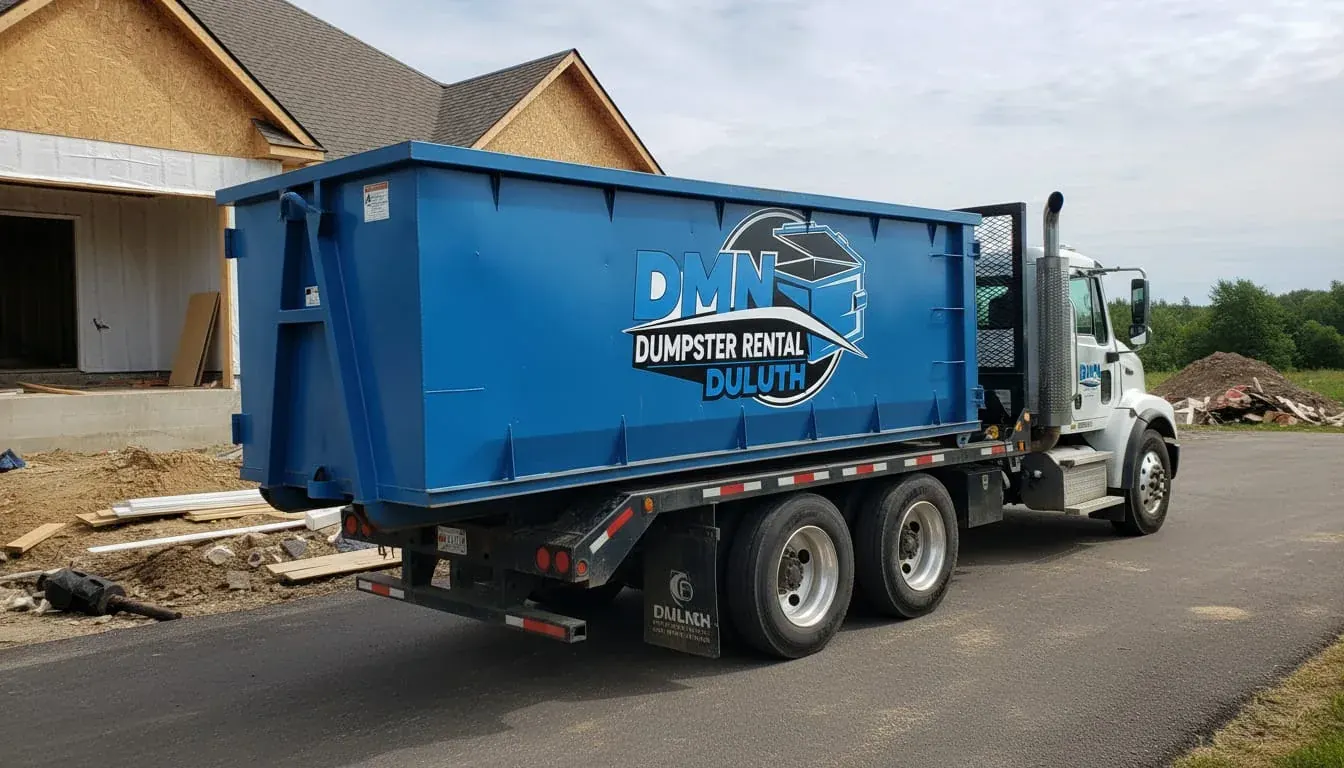
A dumpster sitting on your own driveway in Duluth is one of the few permit-free decisions left in a home renovation. A dumpster sitting in the street, an alley, or the boulevard is a different matter, and the City of Duluth has an actual permit process for it. This guide covers what triggers a permit, what doesn't, how the older hillside neighborhoods complicate alley placement, what winter does to a container parked at the curb, and how the rules shift once you cross into Hermantown, Proctor, Cloquet, Carlton County, or over the bridge into Superior, Wisconsin.
None of this replaces a call to the actual permitting office. Ordinances get amended and every property has its own quirks. Where we could verify a specific fee, bond amount, or timeline against the City of Duluth's own published permit information, we've included it. Where we could not confirm a number for a smaller surrounding city or township, we say so and point you to who to call instead of guessing.
If a roll-off container sits entirely on your driveway or yard, Duluth's obstruction-permit rules generally do not apply, since those rules are written around the public right-of-way — streets, alleys, sidewalks, and boulevards — not private land. For most residential projects — a garage cleanout, a kitchen remodel, a roofing tear-off — parking a 20-yard dumpster on the driveway is the simplest path and typically requires no City permit.
The qualifier matters. Driveway aprons and property lines don't always line up with where the pavement visually ends, and a container that overhangs the sidewalk or spills onto the boulevard strip can cross into right-of-way territory without you realizing it. If your driveway is short, steep, or close to the street, measure before delivery. Call (218) 514-6269 and we'll help you figure out whether your spot is clear.
If there's nowhere to put a container except the street, boulevard, or a public alley, Duluth requires an obstruction permit through its Engineering Division within Public Works & Utilities. The City's permit page states this permit covers "roll-off boxes" along with scaffolding, construction materials, and anything else blocking a street, alley, or sidewalk.
Obstruction permits are applied for online through ePlace, and per Duluth's own published permit information, applicants need a $10,000 surety bond and a general comprehensive liability insurance policy in place before the permit can be issued. The City's fee schedule lists a minimum fee of $58.00, with additional charges if the placement occupies parking spaces or meters, if the location is downtown, or if "no parking" signs need to be posted. If your project also requires closing part of a road to traffic, the City requires those applications at least 5 business days before the closure date.
Bond and insurance paperwork takes time, so don't wait until delivery day to start this process. Reach Duluth Engineering at (218) 730-5200, or call us at (218) 514-6269 and we'll help point you to the right form. The City's code also adds a penalty on top of the permit fee if an obstruction is placed before the permit is actually granted, so "we'll apply after it's delivered" isn't a safe shortcut.
Duluth declares snow emergencies most winters, and the City's own snow-emergency guidance is blunt about anything left in the way of a plow route: vehicles that block streets during plowing get ticketed and towed once plows can't get through. The City doesn't publish a dumpster-specific version of that rule, but a container sitting in a traffic lane or blocking a plow's turning radius falls under the same obstruction framework as a parked car — and unlike a car, nobody can move it in five minutes once a snow-emergency notice goes out.
Practically, a street-placed dumpster during plowing season needs a plan: confirm with Engineering how obstruction permits interact with alternate-side parking and snow routes, and budget for the possibility of being asked to relocate the container on short notice. For most winter projects, driveway placement avoids the problem. See our winter dumpster rental guide, and if your driveway has any grade, our steep-driveway placement guide too.
Duluth's older hillside neighborhoods — the platted grid running up from the lake through Central Hillside, Woodland, and parts of East and West Duluth — were built with service alleys behind many lots, and an alley is often the only flat spot for a container when a driveway is too narrow, too steep, or nonexistent. A public alley is still public right-of-way, though, so alley placement is treated the same as street or boulevard placement, not as an exception to it — the City's permit language groups alleys explicitly alongside streets and sidewalks.
A few alleys in older plats have been vacated over the years and are technically no longer public right-of-way, but don't assume that's the case for yours without checking with the City's Engineering staff.
Duluth has a Heritage Preservation Commission that reviews work affecting locally designated historic properties and districts, including recognized areas around downtown and the Central Hillside. If your project involves exterior work on a home within one of those areas — a facade change, replacement windows, a porch rebuild, roofing visible from the street on a contributing structure — confirm with the Commission's staff whether design review applies before generating debris. That's a separate question from whether the dumpster itself needs a permit, and the exact list of designated properties is something the Commission's staff can confirm for your specific address.
Whether you need a City obstruction permit for the container and whether your project needs a City building permit are separate questions, and it's easy to clear one and forget the other. A dumpster parked on a driveway may need no permit at all, while the work filling it — a roof tear-off down to the sheathing, removal of a load-bearing wall, a full demolition, or other structural change — almost always needs a building permit regardless of where the container sits. Cosmetic work like re-shingling over existing sheathing or a straightforward interior cleanout generally doesn't trigger a building permit, but the line between "reroof" and "reroof with sheathing replacement" is worth confirming with Duluth's building inspection staff before you start tearing into a roof deck. Our roofing tear-off guide covers what typically ends up in the dumpster on that kind of job.
DMN Dumpster Rental delivers well beyond Duluth's city limits, and every surrounding jurisdiction sets its own rules independent of Duluth's. Hermantown, Proctor, Rice Lake Township, Cloquet, and Carlton County each have their own permitting offices, and none are bound by Duluth's obstruction-permit ordinance or fee schedule. On the Wisconsin side, Superior isn't just a different city — it's a different state, with its own building and public works departments, its own forms, and its own fees. Douglas County, Wisconsin handles land-use permitting for unincorporated areas outside Superior's city limits.
We don't publish a fee or timeline for these smaller jurisdictions because they change, and we'd rather send you to the source than get it wrong. If your project touches a public street, alley, or right-of-way outside Duluth, call that city, township, or county's own office before delivery. We serve Superior, Hermantown, Proctor, Cloquet, Carlton, Rice Lake, and the rest of the Twin Ports region regularly, and can often tell you from experience whether a given city tends to be strict about curb placement — though that's local knowledge, not a substitute for calling the permitting office yourself.
A City permit, or the lack of one, has nothing to do with whether your homeowners association, landlord, or condo board allows a dumpster on the property. Many HOAs restrict where containers sit, how long they stay, or require advance notice to the board, and those rules apply even when no municipal permit is required. Renters should check with the property owner before scheduling delivery, since a City-compliant placement can still violate a private agreement. This is a separate approval track from anything the City of Duluth or surrounding counties administer, and it's usually the fastest one to sort out.
| Placement Type | Permit Likely Needed? | Who to Ask |
|---|---|---|
| Driveway or private yard (Duluth) | Generally no City permit | Confirm property lines if driveway is short or narrow |
| Street, boulevard, or public alley (Duluth) | Yes — City obstruction permit | City of Duluth Engineering Division, (218) 730-5200 |
| Historic district exterior work generating debris | Possibly — design review for the work itself | Duluth Heritage Preservation Commission |
| Street/right-of-way in Hermantown, Proctor, Cloquet, Rice Lake | Rules vary by city/township | That city or township's own permitting office |
| Street/right-of-way in unincorporated St. Louis or Carlton County | Rules vary by county | County zoning or highway department |
| Street/right-of-way in Superior or Douglas County, WI | Yes, likely — separate Wisconsin process | City of Superior Public Works or Douglas County, WI |
| Any placement under an HOA, condo association, or lease | Separate approval, regardless of City permit status | HOA board, property manager, or landlord |
If you're weighing size against placement, our dumpster size guide and Duluth pricing guide cover the other variables that usually decide where a container ends up sitting. If this sounds like more coordination than you want to handle alone, that's what we're here for — reach out through our contact page and we'll help sort out placement, size, and timing before delivery day.
FAQs
Generally, no. Duluth's obstruction-permit rules are written around the public right-of-way — streets, alleys, sidewalks, and boulevards — not private property. A container that sits entirely on your driveway or yard typically falls outside that requirement. If your driveway is narrow or the property line is unclear, confirm placement before delivery.
You'll need an obstruction permit from the City of Duluth's Engineering Division, applied for through the City's online ePlace portal. Duluth's published permit information lists a $10,000 surety bond and liability insurance as requirements before issuance, a minimum fee of $58.00 (more if parking spaces, meters, or a downtown location are involved), and at least 5 business days' notice if a road closure is also needed. Confirm current details directly with Duluth Engineering at (218) 730-5200.
That's a real risk. Duluth's snow-emergency guidance states that vehicles blocking a plow route get ticketed and towed once plows can't get through, and a roll-off container in a traffic lane or turning radius would reasonably fall under the same obstruction framework. Unlike a car, it can't be moved in five minutes, so a curbside placement during plowing season needs a plan — or should be moved to a driveway instead.
Yes, in most cases. Duluth's obstruction-permit rules group public alleys alongside streets and sidewalks as right-of-way, so alley placement generally requires the same permit as street placement. A small number of older alleys have been officially vacated and are no longer public right-of-way, but don't assume that applies to your alley without checking with the City.
No. Each city, township, and county sets its own rules independently of Duluth, and Superior is in a different state entirely, with its own Wisconsin permitting process through the City of Superior and Douglas County. If your project is outside Duluth city limits, contact that local jurisdiction's own office rather than assuming Duluth's obstruction-permit process applies.
Ready when you are
Call and you will speak to someone local who knows the streets, the permit rules and which box actually fits your driveway. Flat rate quoted up front.
Keep reading
How Duluth contractors handle C&D debris classification, plaster and lath weight traps, load legality, and spring load restrictions correctly.
A practical, room-by-room guide to clearing a parent's Duluth home: what to save before anything is thrown away, where to donate locally, and how to pace the work.
Squares, shingle weight per layer, ice dams, snow load, hillside placement, winter tear-offs, and permits — how we size a Duluth re-roof dumpster.